
Technology Isn’t Killing Hospitality. We Are.
- Aug 11
- 6 min read
Why the next winners in travel will use technology to protect humanity, not replace it.
By Casey Davy, CEO, Breeze Travel Solutions
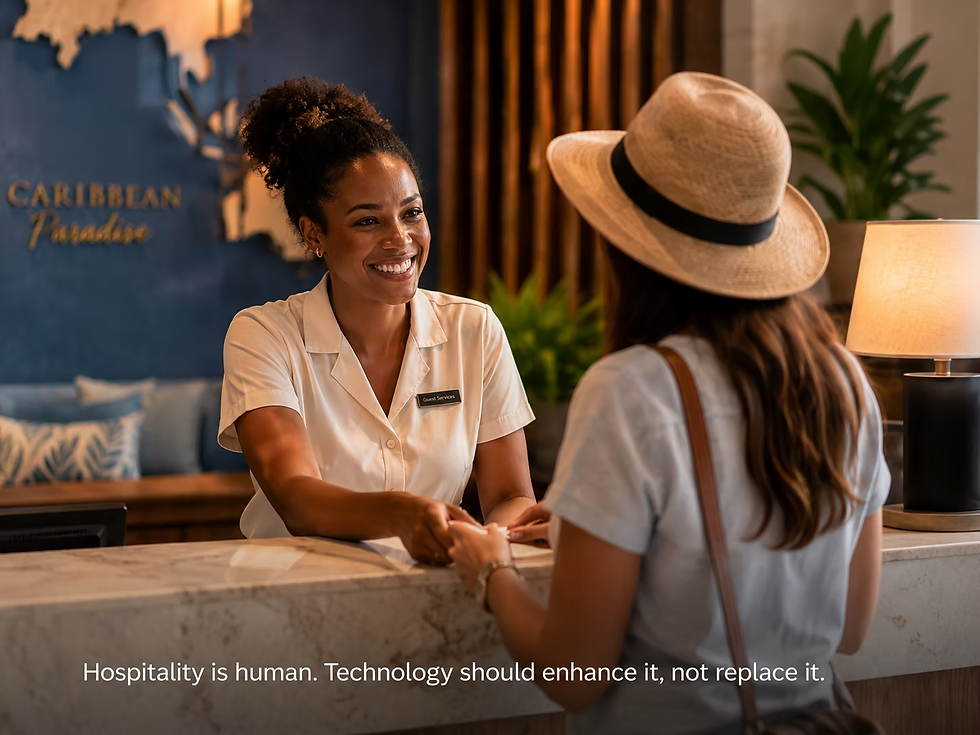
This may sound strange coming from the CEO of a travel technology company.
But I believe the travel industry is making a serious strategic mistake. We are not simply using technology to improve hospitality. Too often, we are using it to remove hospitality from the experience altogether.
We automate the welcome.
We replace conversations with chatbots.
We force travelers through self-service processes when they are already frustrated.
We collect more information about guests while sometimes knowing less about how they actually feel.
Then we call it innovation. The problem is not the technology. The problem is that leaders are automating the wrong moments. Technology has never been the destination. It was always supposed to be the bridge.
Efficiency Is Not the Same as Hospitality
I have spent more than two decades working across travel technology, digital platforms, distribution, automation and artificial intelligence.
I believe deeply in what technology can do.
It can reduce costs, eliminate repetitive work, improve conversion, connect fragmented suppliers, anticipate traveler needs and help businesses operate at a scale that would otherwise be impossible.
But efficiency alone does not create loyalty.
A traveler may appreciate a frictionless booking process, but that is rarely the story they tell when they return home.
They remember the concierge who remembered their child’s name.
They remember the hotel manager who took ownership when something went wrong.
They remember the chef who explained the history behind a family recipe.
They remember the guide who introduced them to a community rather than simply moving them through an itinerary.
They remember how the experience made them feel.
That emotional memory is not a soft benefit. It influences trust, recommendation, repeat business and ultimately customer lifetime value.
Trust Is Becoming More Valuable as AI Expands
The more sophisticated technology becomes, the more valuable human accountability may become.
Expedia Group’s 2026 AI Trust Gap research found that 68% of travelers would still prefer to book with a trusted travel brand rather than through an AI platform. While many travelers are increasingly comfortable using AI for inspiration and recommendations, significantly fewer are prepared to hand over the entire booking decision.
That distinction matters.
Travelers may allow AI to research, compare, inspire and recommend. But when thousands of dollars, a family holiday or an important milestone is at stake, they still want confidence that someone will take responsibility when something goes wrong. AI can generate an itinerary in seconds. But when a flight is cancelled, a hotel cannot find the reservation or a traveler is stranded late at night, the most important question becomes:
Who owns the problem? That is where trust is built or destroyed.
The New Luxury Is Feeling Seen
The definition of luxury is changing. Luxury is no longer defined only by marble bathrooms, larger suites, private transfers or expensive champagne.
Those things still matter, but increasingly, they are simply expected. The deeper luxury is feeling seen.
Feeling welcomed.
Feeling understood.
Feeling that someone genuinely cares whether the experience exceeds expectations.
Hilton’s travel research has identified human connection and the desire to disconnect from digital devices among important motivations for luxury travelers. American Express Travel has also reported that 70% of surveyed Millennials and Gen Z enjoy planning trips where the journey matters as much as the destination.
Travelers are not simply buying rooms, seats or itineraries.They are buying confidence, discovery, connection, belonging and memories. And increasingly, they are looking for experiences that recognize them not simply as customers, profiles or data points but as people.
That changes the competitive equation. The advantage is no longer just the quality of the physical product. It is the quality of the feeling surrounding it.
Because in a world where technology can personalize almost anything, genuine recognition may become one of hospitality’s most valuable forms of luxury.
A Better Rule for Travel Technology

Every travel company and destination should evaluate technology according to a simple principle: Automate transactions. Augment decisions. Protect emotional moments.
Automate transactions that are repetitive, predictable and low-emotion: confirmations, payments, document collection, routine administration and updates.
Augment decisions where technology can make employees and travelers better informed: recommendations, itinerary design, disruption management, demand forecasting and personalization.
Protect emotional moments where empathy, judgment, reassurance and cultural knowledge create value: welcomes, celebrations, complaints, disruptions, special requests and meaningful interactions with communities.
A guest should never be forced to fight through a chatbot while dealing with a cancelled anniversary trip. A frontline employee should not need five levels of approval to solve a simple guest problem. And personalization should mean more than inserting someone’s first name into an automated email.
The best travel technology becomes almost invisible. The guest does not admire the system.
They simply experience a better journey.
The Caribbean Should Compete on What Cannot Be Copied
This creates an enormous opportunity for the Caribbean. The region welcomed approximately 35 million stay-over visitors in 2025. But the next phase of Caribbean tourism cannot depend simply on increasing visitor numbers year after year. The Caribbean Hotel and Tourism Association and Amadeus have highlighted a shift toward smarter targeting, higher-value travelers, market diversification and stronger year-round demand.
This is where the Caribbean has a natural advantage. Our greatest tourism assets are not only our beaches and hotels. They are
Our people.
Our music.
Our food.
Our stories.
Our communities.
Our history.

Our ability to make a visitor feel they have been welcomed into something real. The Caribbean should not try to out-build Dubai. We should not try to become another Miami. We should become the global benchmark for authentic, technology-enabled hospitality.
Buildings can be copied. Technology can be licensed. Prices can be undercut. Authentic culture and human connection are far harder to replicate. That is our competitive advantage.
Technology Must Strengthen Stewardship
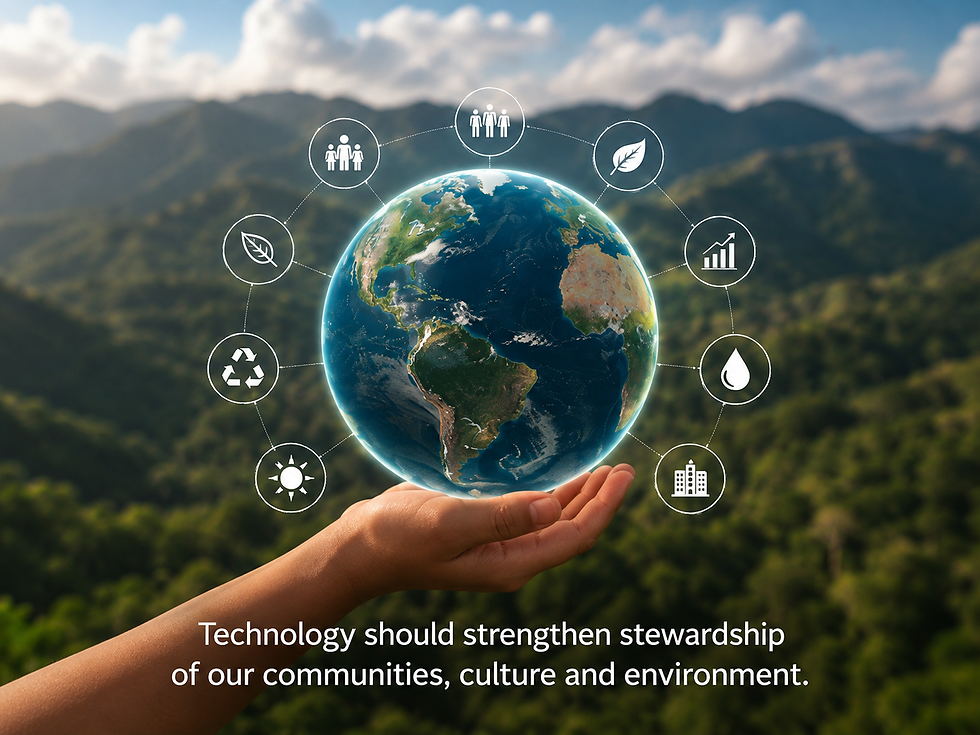
Hospitality is not simply about serving guests. It is also about stewardship.
Stewardship of culture.
Stewardship of communities.
Stewardship of the environment.
Stewardship of the memories travelers will carry home.
Booking.com’s 2026 sustainability research found that 85% of travelers consider more sustainable travel important, while substantial numbers are looking to avoid overcrowded destinations and travel outside traditional peak seasons.
Technology can help destinations respond. It can use demand intelligence to distribute visitors across different communities and seasons.
It can connect travelers with local guides, restaurants, farmers, artists and small businesses.
It can help businesses anticipate demand, reduce waste and manage capacity.
It can give smaller tourism operators access to distribution that was previously available only to large companies.
But this requires deliberate leadership. If a destination digitizes only its largest hotels and most established attractions, technology will concentrate value rather than distribute it.
If a platform makes it easier to book a destination but directs little economic value toward the people who create its culture, we may have improved the transaction without improving tourism.
Technology should not merely extract more value from a destination. It should help create and retain more value within it.
The Hospitality Technology Test
Before approving the next AI platform, chatbot, self-service system or automation project, every travel CEO should ask five questions:
Does this remove friction for the traveler—or simply transfer work from the company to the customer?
Does it give employees more time and authority to serve—or merely reduce human contact?
Does it help us understand the guest—or simply help us collect more data?
Does it strengthen trust and accountability when something goes wrong?
Will it improve the experience people remember—or only the transaction they forget?
If the investment cannot answer those questions convincingly, it may reduce costs without creating meaningful long-term value.
A Challenge to the Industry
The next generation of winners will not necessarily have the largest technology budgets, the most sophisticated AI or the most impressive booking engines. They will be the companies and destinations that understand where technology creates value and where humanity creates even more. People travel to feel something. Technology can remove the barriers to that feeling. It can make the journey easier, more relevant, more accessible and more personalized. But it cannot manufacture genuine care.
Our responsibility as technology leaders is not to automate humanity. It is to use technology to give people more time, information and freedom to practise it. Because people may discover and book through technology. But they trust, recommend and return because of how people made them feel.


Comments